
The European
Business Wallet
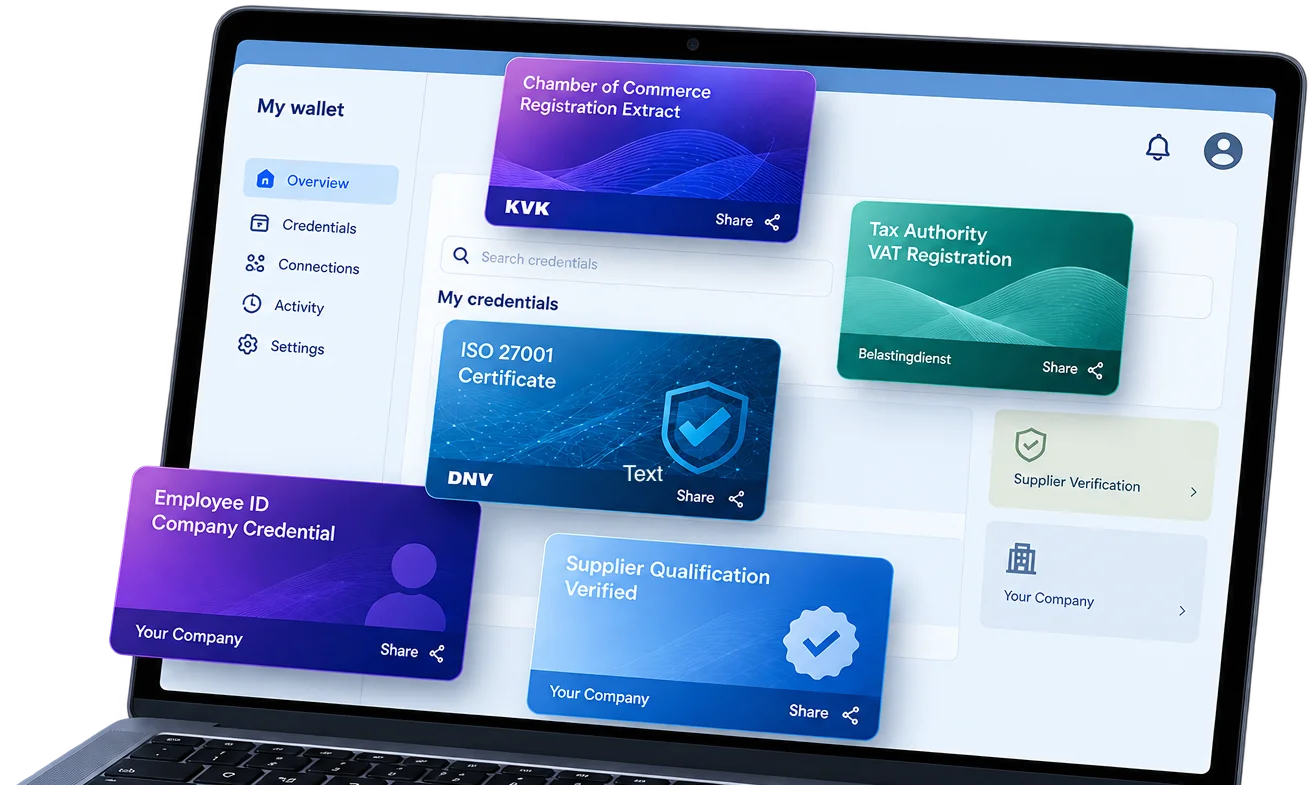
A Business Wallet is a digital identity wallet for an organisation, not a person. COM(2025) 838 would establish a European Business Wallet.
It would give every company, institution and public body in the EU one legally recognised way to prove who it is, who may act on its behalf and which credentials it holds: across borders, in seconds, without sending another scanned PDF.
 eIDAS 2.0European Digital Identity
 OpenID Foundation

What a Business Wallet enables
Organisations need more than a digital identity. They need a trusted way to identify themselves, prove who they are and what they can do, represent their organisation, and act securely on that basis. A Business Wallet brings these capabilities together — from establishing organisational identity to sharing trusted credentials, managing representation and authorisations, and enabling trusted transactions.
See the full comparisonWho is the organisation?
Identity · Registration · Business details
An organisation would establish and share its verified identity, so a counterparty could check its legal identity, registration and business details against the source instead of taking a document on trust.
What can the organisation prove about itself?
Credentials · Certificates · Licences · Attributes
It would hold what it has been issued and prove facts about itself with trusted digital credentials, certificates, licences and other verifiable attributes.
Who can act on its behalf?
Mandates · Authorisations · Roles · Representation
It would show who is authorised to act on its behalf, for which purpose and within which scope, connecting people, organisations and authority.
How can it act with trust?
Sign · Seal · Send · Verify
It would exchange trusted information with other organisations and public authorities, sign and seal transactions, and verify who it is dealing with and what they are authorised to do.
Who governs the European Business Wallet?
The European Business Wallet is not governed by a single wallet provider. It sits inside a European legal and regulatory framework, with responsibilities shared across several actors.
European Union
Sets the legal framework and the common requirements every Business Wallet must meet.
European Commission
Develops the implementing acts and technical specifications that turn the regulation into detailed requirements.
Member States
Implement the framework nationally and designate the competent authorities responsible for supervision.
Authoritative sources
Business registers, tax authorities and other bodies that provide the trusted source information credentials are built on.
Qualified Trust Service Providers
Issue qualified trust services and electronic attestations that carry legal weight under eIDAS.
Wallet providers
Build and operate Business Wallet solutions that meet the common European requirements.
Businesses
Manage and use their own organisational credentials, mandates and authorisations.
Relying parties
Request and verify the trusted business information a wallet presents.
Standards organisations
Develop the open, interoperable technical standards the framework relies on.
What the proposal would mean for you
The obligations and options in COM(2025) 838 land differently depending on what kind of organisation reads it.
Businesses and SMEs
What would stay optional, what a Wallet could be used for, and the cost estimates the Commission has published.
Read more about Businesses and SMEsPublic administrations
The acceptance obligations the proposal would place on public sector bodies, and by when.
Read more about Public administrationsBanks and regulated sectors
What a Business Wallet could prove about a corporate counterparty, and why accepting one would stay a commercial choice.
Read more about Banks and regulated sectorsIssuer, holder, verifier: three roles, one organisation
Under the EUDI Wallet, a person is mostly a holder. Under the proposal, an organisation would be able to take on all three roles, sometimes at once, each checked against the same EU trust lists.
Issuer
The organisation would issue verifiable credentials of its own, signed statements a counterparty can check without calling back: the same role chambers of commerce, tax authorities and regulators already play toward it.
Holder
Credentials issued to the organisation, registration data, legal status, authorisations, certificates, would live in its Business Wallet. The organisation itself is the holder, not an employee and not a platform.
Verifier
When a counterparty presents a credential, the organisation would check its signature, issuer status and validity directly against EU trust lists: instantly, and without contacting the issuer.
Built for every business interaction
From compliance and procurement to supply chains and permits: wherever an organisation has to prove something about itself.
Compliance and legal filings
Registration extracts, tax standing, licences and annual statements shared as credentials with a verifiable issuer.
Public procurement
Submit an ESPD once and reuse it. Contracting authorities verify eligibility without requesting the same evidence twice.
KYC and due diligence
Onboard a counterparty in minutes: legal status, ownership, mandates and signatories checked at source.
Supply chain and product data
Certificates of origin, conformity and sustainability travelling with the goods instead of in an inbox.
Access, permits and licences
Request, hold and present permits and access rights digitally: on site, at the gate, or in a portal.
E-invoicing and e-delivery
Sealed invoices and legally reliable delivery of documents, with evidence of who sent what, and when.
From issued credentials to trusted interactions
Five moves would take an organisation from a paper trail to a verifiable one. Scroll to follow them.
Issuers issue
Chambers of commerce, tax authorities, regulators and certification bodies issue verifiable credentials about the organisation: signed at source, checkable forever.
The organisation holds
They land in the Business Wallet: registration data, legal status, authorisations, certificates. The organisation is the holder, not an employee, not a platform.
People are authorised
Mandates issued from the Business Wallet land in each representative's personal EUDI Wallet, proving who may act, and within which limits.
Only what is asked for
When a counterparty asks a question, the wallet answers exactly that question. Selective disclosure keeps everything else private.
The relying party verifies
Signatures, issuer status and validity are checked against EU trust lists: instantly, without calling anyone, and without a bilateral integration.
Under the Commission's proposal the Business Wallet would be issued to legal persons, while the EUDI Wallet stays with natural persons. The two are designed to work together.
A growing ecosystem of business wallets
Providers across Europe are building wallets for organisations. These are listed in the FIDES ecosystem explorer.

Credenco Business Wallet
A DIIP v5 compliant business wallet platform with holder, issuer and verifier capabilities.
Learn more about Credenco Business Wallet
Gataca Studio
Gataca Studio is a cloud-based digital identity platform enabling organizations to interact with ID wallets.
Learn more about Gataca Studio
Identfy Business Wallet
Identfy Business Wallet is an enterprise-grade organizational identity solution designed for managing, issuing and presenting corporate verifiable credentials in B2B and...
Learn more about Identfy Business Wallet
Inji Verifier
An open-source verification component by MOSIP enabling organizations and relying parties to verify verifiable credentials using OpenID4VP.
Learn more about Inji Verifier
Sphereon VDX platform
Sphereon VDX is a verifiable data layer for policy-driven trust and audit-ready decisions.
Learn more about Sphereon VDX platformExplore European Business Wallet demos
Experience the capabilities of the European Business Wallet through one of these demos, and discover how it can improve digital interactions.
EU reference implementation
The Commission's open-source reference wallet, issuer and verifier: the baseline every implementation is measured against.
VisitFIDES community
The ecosystem explorer, interoperability events and demos from the organisations building business wallets in Europe.
VisitCredenco playground
Issue a credential to a wallet, present it to a verifier, and watch the trust chain resolve, end to end, in your browser.
VisitQuestions worth asking
Short answers here. Every term links through to a fuller definition in the glossary.
Open the glossary